
Cupping therapy and deep tissue massage are both professional treatments designed to address muscle and connective tissue problems. At Pepper Leaf Studio in Nenagh, we offer both — and the question we hear most often from clients who are familiar with one but not the other is: which one should I choose? The answer depends on the nature of your concern, your body type, and what previous treatments have or haven’t worked for you. This guide explains the key differences.
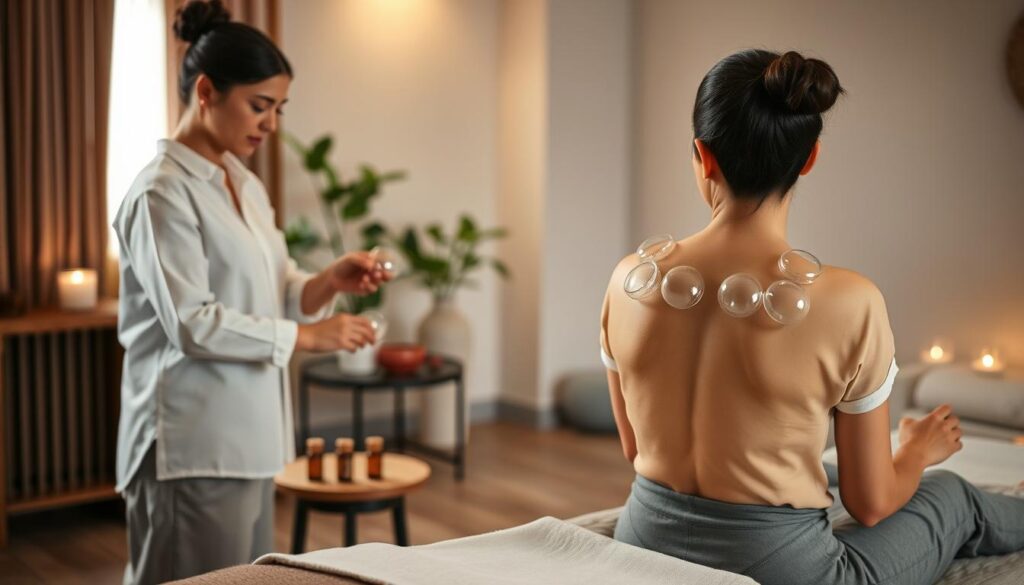
Both treatments are available at Pepper Leaf Studio, Nenagh
Book a Cupping Therapy or Deep Tissue Massage session — or ask your therapist about combining both. Book Cupping Therapy →
The Fundamental Difference: Lifting vs Compressing
This is the most useful way to understand the distinction between the two treatments.
Deep tissue massage applies sustained downward pressure into the muscle tissue. The therapist works through the superficial layers progressively and applies firm, directional strokes to the deeper muscle fibres and the fascia beneath. This compression technique is highly effective for releasing muscle tightness — it increases blood flow, warms the tissue, and manually breaks down the adhesions within individual muscle fibres.
Cupping applies suction to the skin surface, drawing the tissue upward rather than pressing it downward. This decompressive action lifts and separates the fascial layers — the connective tissue web that surrounds and connects muscle groups — creating space and increasing blood flow in a way that compression-based treatment cannot achieve as effectively in the fascial layer.
In practice, this means the two treatments are often targeting the same area but at different structural levels and through opposite mechanical actions.
Which Is Better for Fascial Restriction?
Fascia responds well to sustained decompression. When it has become thickened and restricted — through chronic tension, poor posture, or injury — compression often produces only temporary improvement because the fascial adhesion remains intact. Cupping, with its sustained lifting action, is frequently more effective at releasing established fascial restriction and producing longer-lasting improvement in mobility.
If you have tight areas that seem to loosen temporarily after massage but consistently return to tightness within a few days, this often points to a fascial component that compression alone isn’t fully addressing. In these cases, cupping typically produces better sustained results.
Which Is Better for Deep Muscle Tightness?
For tightness that is primarily in the muscle fibres rather than the fascia — the kind caused by overuse, heavy physical work, athletic training, or acute postural strain — deep tissue massage is often the more direct and effective approach. The directional compression and specific muscle-targeting techniques available to a deep tissue therapist allow for precise work on individual muscle groups in a way that cupping, which treats a broader area through suction, cannot replicate.
Prefer the Deep Tissue Massage?
Available as a 1-hour or 1.5-hour session — targeted compression to release deep muscle tightness. Book Deep Tissue Massage →
Which Is Better for Different Body Types and Sensitivity Levels?
If you find strong pressure difficult to tolerate: Cupping is often preferable. The suction sensation is different from pressure — a pulling or stretching feeling — and many people who find deep pressure painful find cupping manageable and comfortable at an equivalent treatment intensity.
If you have a high pain tolerance and respond well to deep work: Deep tissue massage often produces more immediately satisfying results because the therapist can apply specific, targeted pressure to exactly the areas that need it.
If your skin is sensitive to the marking effect of cupping: Deep tissue massage may be the better ongoing choice, as it produces no visible skin marks. It is worth noting, however, that cupping marks fade within three to seven days and are not harmful — they simply reflect areas of restricted circulation in the treated tissue.
Can You Combine Cupping and Deep Tissue Massage?
Yes — and combining them is often the most effective approach for complex or long-standing tension. A common strategy is to use cupping to address the fascial layer and improve blood flow in the area, followed by deep tissue work on the muscle fibres that the improved tissue state makes more accessible.
Some therapists integrate both approaches within a single session. Others recommend alternating between the two across a course of treatment based on how the tissue responds. At Pepper Leaf Studio, your therapist will discuss the options with you and recommend the combination most appropriate to your specific situation.
For more detail on how cupping works as a standalone treatment, our guide to cupping therapy for stress and tension covers the mechanism and benefits in depth. Our massage therapy guide provides an overview of all the massage options available at Pepper Leaf Studio, including Holistic Massage, Hot Stone Massage, and Lymphatic Drainage.
Summary: Which to Choose
- Choose cupping if you have persistent tension that massage has not fully resolved, if you suspect fascial restriction, if you find strong pressure difficult to tolerate, or if you want a treatment that addresses the whole area rather than specific muscle groups.
- Choose deep tissue massage if your tension is primarily muscular, if you respond well to direct pressure, if you need precise targeted work on specific muscle groups, or if you need to avoid visible skin marking.
- Combine both for complex, long-standing tension with both fascial and muscular components — or as a maintenance strategy that addresses different layers in alternating sessions.
Frequently Asked Questions
Are both treatments available on the same day?
This depends on the session length and your therapist’s assessment of what your body needs. In some cases a single extended session can incorporate elements of both. In other cases, spacing the treatments is more appropriate. Discuss this with your therapist at the time of booking or at the start of your session.
Which one is better for sports recovery?
Both are used in sports recovery contexts. Deep tissue massage is typically preferred for targeted muscle recovery after specific exertion. Cupping has gained particular traction among athletes for its ability to clear metabolic waste products from overtaxed tissue and reduce recovery time. Many serious athletes use both at different points in their training cycle.
Which one is less likely to leave me sore the next day?
Post-treatment soreness is possible with both, and is a normal response as the treated tissue recovers. It is typically mild and resolves within 24 to 48 hours. Cupping may produce visible marks that last several days; deep tissue massage may produce muscle soreness without visible marking. Neither should produce significant pain — if it does, communicate this to your therapist.
- Cupping therapy: benefits and evidence — Healthline
- Deep tissue massage: benefits and what to expect — Healthline
Related Treatments at Pepper Leaf Studio, Nenagh
- Cupping Therapy (1 Hour) — decompressive suction treatment for fascial restriction
- Deep Tissue Massage (1 Hour) — targeted compression massage for deep muscle release
- Cupping Therapy (1.5 Hours) — longer cupping session for more extensive coverage
- Hot Stone Massage — warming relaxation massage with heated basalt stones
Keep Reading
- Cupping Therapy in Nenagh: Benefits for Stress, Tension, and Recovery
- Back Massage in Nenagh: Deep Tissue and Chair Massage at Pepper Leaf Studio
- Massage Therapy Nenagh: Which Massage Is Right for You?
Further Reading
- ↗Mayo Clinic: Massage Therapy — Evidence and Benefits — How deep tissue massage affects muscle tension, pain and recovery — from an independent clinical perspective.
- ↗Mayo Clinic: Cupping Therapy — What the evidence says about cupping for pain, inflammation and muscle release — how it compares to massage.
- ↗Healthline: Cupping Therapy Explained — A medically reviewed guide to cupping — technique, benefits, and how it differs from traditional massage.
Not sure which treatment to book?
A free skin and wellness consultation at Pepper Leaf Studio helps you choose the right treatment for your body. Book a Free Consultation →